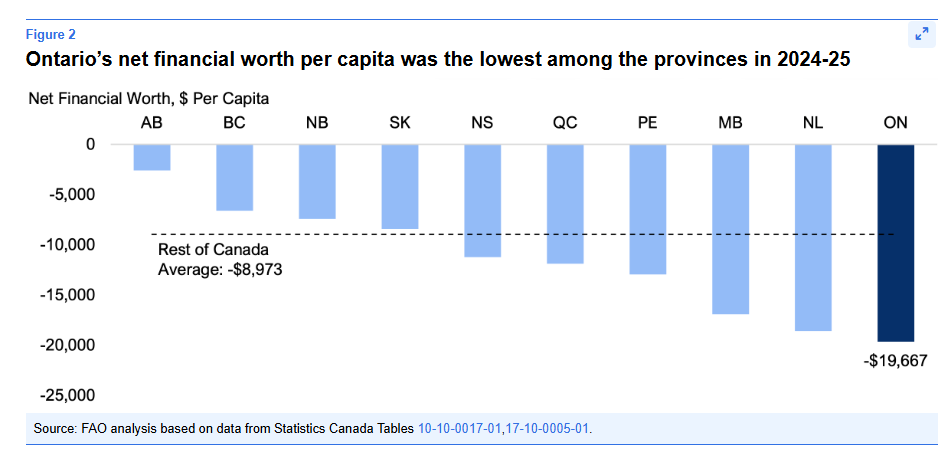
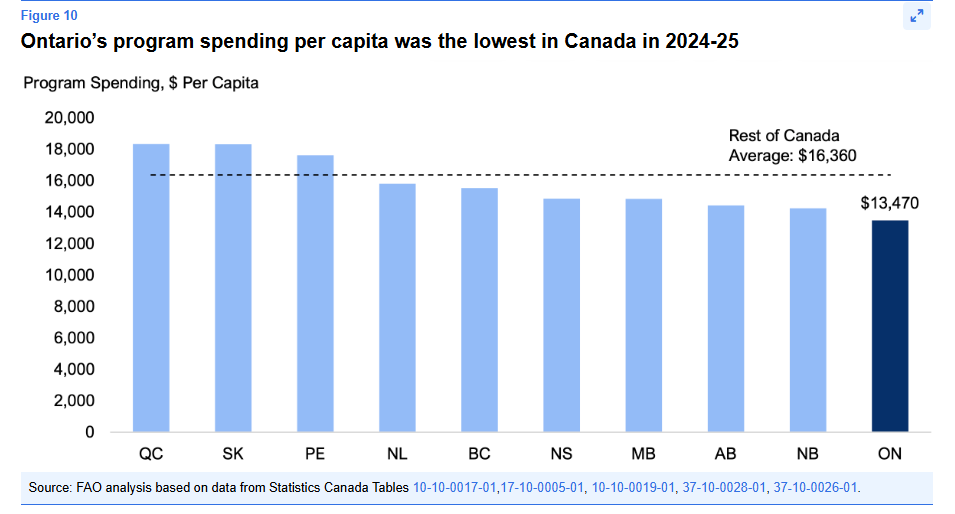
The Financial Accountability Office of Ontario (FAO) recent report compares 2024-25 Government of Ontario financial statistics against the other Canadian provinces based on Statistics Canada’s Government Finance Statistics (GFS). Ontario’s net operating balance, the difference between total revenue and total spending, was a deficit of $1,137 per capita in 2024-25, similar to the rest of Canada average of a net operating deficit of $1,131 per capita. Only three provinces – Alberta, New Brunswick and Nova Scotia – recorded net operating surpluses in 2024-25.
Ontario generated $13,333 in total revenue per capita in 2024-25, the lowest among the provinces and 19.6 per cent below the rest of Canada average ($16,576 per capita). Ontario’s relatively low revenue per capita resulted from above-average taxation revenue per capita that was more than offset by below-average federal transfers and other non-tax revenue per capita.
Ontario received $2,217 per capita in federal transfers, the lowest among the provinces and $1,097 (33.1 per cent) below the rest of Canada average ($3,314). Ontario’s lower federal transfers in 2024-25 reflect its low level of Equalization Program payments and its below-average revenue from other federal transfer programs.
Ontario’s total spending per capita was $14,470 in 2024-25, the lowest among the provinces and 18.3 per cent below the rest of Canada average ($17,707 per capita). Ontario’s relatively low spending per capita resulted from below-average per capita program spending (health, education and all other programs) and interest on debt payments.
Finally, Ontario’s net financial worth, the difference between financial assets and financial liabilities, was -$19,667 per capita in 2024-25, the lowest among the provinces and 119.2 per cent below the rest of Canada average (-$8,973 per capita). Measured against each province’s Gross Domestic Product (GDP), Ontario’s net financial worth (-26.5 per cent of GDP) was the lowest among the provinces and below the rest of Canada average (-11.8 per cent of GDP). To learn more, read the full report here. |
|
| |
Ontario is entering a period of sustained and accelerating change.
Population growth, housing pressures, climate resilience, infrastructure demands, and technological transformation are reshaping communities across the province.
These challenges do not sit neatly within institutions. They move across systems —affecting how organizations operate and how communities function.
Municipalities are at the centre of many of these pressures. But solutions increasingly extend beyond any single organization.
This is an environment where leadership cannot operate in isolation.
Stay tuned as we will soon have a new name, followed by a new look. |
|
|
|
Project Executive – Regional Conservation Authority |
The Project Executive (PE) will serve as the key change champion and senior transition leader responsible for overseeing and serving as Chair of a Transition Committee for a group of consolidated Conservation Authorities (CAs) that will collectively form a new Regional Conservation Authority (RCA). Reporting to the Chief Executive Officer (CEO) of OPCA, the PE will lead the design, coordination, and execution of transition strategies that will inform the operations and organizational structure of the newly established RCA and will transition to the inaugural Chief Administrative Officer (CAO).
The role requires a seasoned executive capable of navigating complex, multi-stakeholder environments, leading large-scale transformation, and applying sound judgment in high impact decisions. The PE will be a strategic, diplomatic, visionary leader with operational discipline, political acuity, and the ability to unify multiple groups under a shared purpose. This will require exceptional business acumen with experience leading large multi-disciplinary teams.
Key Responsibilities Lead multi-year project planning and provide executive-level oversight and accountability for the Transition Committee responsible for the consolidation of a group of Conservation Authorities
Implement project governance frameworks, risk management strategies, and performance measurement tools Build and maintain collaborative relationships within a multi-stakeholder governance model including Board members, provincial ministries (MECP, MNRF), Indigenous communities, and community organizations Lead, mentor, and develop multidisciplinary teams
Foster a culture of accountability, collaboration, innovation, and continuous improvement Oversee leadership, talent management, performance management, and professional development Develop and manage large-scale budgets within a multi-funding model, grant applications, and capital expenditure plans Monitor financial performance enterprise-wide Ensure compliance with the Conservation Authorities Act, and other relevant legislation Oversee the structured wind-down of predecessor Conservation Authority operations, including asset transfers, staff transitions, and liability resolution
Navigate complex labour relations matters arising from consolidation, including collective agreement harmonization and workforce transition planning Recruitment process to appoint eight (8) Project Executives.
This is a fixed-term contract that runs until February 2029. Reports to the Chief Executive Officer, Ontario Provincial Conservation Agency Salary Range: $185,000 to $285,000
Closes 25 May 2026 |
|
|
|
The Town of Hanover is a growing, connected, and vibrant community within the County of Grey. With a population of approximately 8,500 residents, Hanover is proud to serve not only those who live here but also the surrounding region of over 45,000 people who rely on Hanover as a hub for healthcare, recreation, education, shopping, and cultural experiences.
Hanover’s vision is to be a progressive community where residents of all ages enjoy safe, healthy lifestyles, meaningful employment, excellent services, and personal fulfillment. The Town supports growth while respecting and celebrating heritage; enhancing the downtown; protecting natural resources; and welcoming all to a friendly, caring, inclusive and supportive community. Hanover is committed to good government, effective and efficient management and maintenance of municipal services, productive partnerships and collaborating with our local businesses and municipal neighbours to build local economies and community services for our mutual benefit.
Recently, the Town took an important step toward addressing growth challenges through obtaining provincial approval for a boundary adjustment with a neighbouring community. The boundary adjustment will provide additional developable land that has the potential to support new residential, commercial, and industrial growth, broadening the tax base and reducing the burden on existing ratepayers. Hanover’s path forward is clear: thoughtful, well-managed growth will be the key to maintaining affordability, supporting infrastructure renewal, and ensuring that the Town remains a strong, vibrant, and inclusive community for years to come.
With a combined operating and capital budget of over $29M and 165 permanent and part-time staff, the Town of Hanover is committed to meeting the needs of residents and the business community by delivering efficient and effective services. Due to the retirement of a well-regarded CAO, Hanover is looking for an inspiring leader to play a key role in implementing Council’s vision for the future.
Leading a talented team, you will inspire a dedicated workforce and help foster a workplace culture focused on service excellence, innovation and teamwork while positioning Hanover as an employer of choice. Hanover offers competitive compensation of $164,764.60 to $191,591.40 plus pension, benefits, vacation, professional development, and an opportunity to work with an engaged Council in a beautiful community.
Closes: 22 May or sooner |
|
|
|
OMAA: Connecting CAOs, Strengthening Municipalities You’re receiving this e-mail because you signed up for the OMAA newsletter.
Was this e-mail forwarded to you? Sign up. Connect with us on: |
| |
| |